Showing posts with label Personal Reaction. Show all posts

Tuesday, November 3, 2015

Chapter 16 Response

   Chapter 16 discusses the very important topic of finding and evaluating sources, which is a skill every Student needs to have. The chapter begins with the sources you can find related to your campuses library such as online catalogs, electronic data bases, reference works, and sources for facts and statistics. The chapter then goes on to explain and define each one of these such as an electronic database is "Libraries subscribe to electronic databases- for example, Expanded academic ASAP or LexisNexis Academic Universe. These are electronic databases enable you to access information from hundreds of newspapers, magazines, and journals." (713-714) The chapter then goes on to discuss the difference of scholar sources you can get from your library vs normal articles you find online. The article explains how to evaluate the source to see if it credible to use in your work. Some of questions you can ask your self while reading an online article can be is it current? Is the author an expert in the subject? Is the information influenced? Does it provide professional examples to shoe it's accurate? Does it cover the subject in depth? Then the chapter explains that when using a source from the library it has already been checked through and approved. So you don't need to worry about those things when using a source from your library.
    My personal reaction of this article is that I know a lot of this information all ready. Growing up in today's generation teachers understand that this is a skill all students need to learn at an early age. The book states to never use Wikipedia, but that is something I've known since my early stages of learning to write research papers in middle school. So overall I personally didn't take anything in from this article, but that doesn't mean this article is a waste. This chapter can possess great information for someone who is returning to college in there late 30's and up who didn't grow up with this information being standard. So this Chapter can be really helpful to the people who need it.

- Timothy Wellmann
b2b marketing

Image source

Thursday, October 1, 2015

Chapter 14 Review.

Argumentation is, essentially, an argument. The point is to persuade the reader to one side or the other. Chapter 14 discusses this in-depth.
Persuasion: how a writer influences the audience to follow a course of action or adopt a belief. (p. 524)
Most argumentative essays are riddled with persuasive points. They can translate over to argumentative points when they become more concrete.
Argumentation: the appeal to reason.

The points that a writer hits to connect with the audience and win them over are what I've known as pathos (emotion), ethos (reputation of the writer), and logos (logical appeal).

This chapter emphasizes the importance of making claims that are well-supported. It reminds us that the audience will mostly be skeptical, and to not assume anything will be understood in the essay unless it is very clearly stated and backed up.
It covers similar topics to the Exemplification chapter, in that support/examples should be relevant, representative, typical, and sufficient. (p 528). Chapter 14 also reiterates the need for documentation or proof of some sort in order to avoid plagiarism.

Things I learned:
A Rogerian argument does not follow the typical wrong/right argument. It involves the agreement points of both arguments, and uses them to find common ground.
Syllogism: consists of a major premise (general statement), minor premise (related but specific statement), and a conclusion.
- This is a type of deductive argument.
There are tons of logical fallacies. Tons. I've done most of them.

Overall, this was a pretty informative chapter. It reviewed a lot for me but also threw in some new things that I wouldn't have associated with argumentative essays.

-Devon

Tuesday, September 15, 2015

Chapter 8 Reading Response

   Chapter 8 explains to readers how to write an exemplification essay. The chapter does a great way of teaching the reader on providing enough examples, choosing a fair range of examples, using transitions, and structuring it.
   I found the information really helpful with how detailed it is on explains what a good example looks like. on page 221 the chapter states "be sure to use transitional words and phrase to introduce your examples." This will help the reader's writing so that their examples feed into each other for a smooth transition.
  Personally this chapter helped me a lot. I learned a lot of ways to portray my examples, and how placement of examples matters.
   I will be referring to this chapter a lot during the next essay thanks to the useful information it presented.

-Timothy Wellmann


example%20clipart

(Image taken from http://www.clipartpanda.com/clipart_images/example-example-clipart-7166633)

Monday, September 14, 2015

Chapter 8: Exemplification

Personal Reaction:

A chapter on exemplification, as one would generally assume, is all about explaining yourself. Using enough examples, placing them in the right spots, and using a variety of them in an essay. The chapter almost over-explains in attempting to get the point across: exemplification makes or breaks an essay. Good essays will have tons of examples, poor essays will have more generalization.
I personally have a relatively easy time with exemplification, but a more difficult time finding a variety of examples to back up my statements.
One of the more important issues addressed in this chapter is the choppiness that can result from having too many examples and not connecting them correctly. Too many staccato paragraphs makes for a difficult to read essay, so the best thing that can be done here is to edit, edit, edit. Edit until the essay flows, take out paragraphs, add in transitions. Edit. A. Ton.
The essays that are seen throughout the chapter do a wonderful job of making it clear how necessary exemplification can be, if the topic requires it. Carefully quoting from a similar work can add depth and persuade the reader to see from the writers point of view.
Overall, this was a fairly informative chapter. It contains a lot of information that I'll be able to refer to later, but also reiterates the importance of organization and having a clear topic.

- Devon D

Monday, August 31, 2015

Personal Reaction, Chapter 3

This chapter felt like a repeat of everything I've learned previously. It refreshed a few things I needed to brush up on, mostly about essay organization and making sure there is enough support in the essay, but that is nothing new. The descriptive checklists are something I will be using in the future, just to double check my work and to make sure I'm asking all the right questions. I doubt I will be consulting it for essay structure, but it never hurts to have a back-up. Mostly, I found this chapter tired and overdone. The Orwell essay was a unique fit for it, and was useful in that it showed a different type of essay than the typical three point, five paragraph style we have all come to know and write on autopilot. 
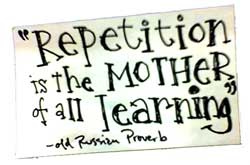
 An old Russian Proverb on a Post-it i have above my desk at work.
The first few chapters in this book have confirmed that this class will help me to start writing for school again, and not just writing for work or to my friends. The chapters do have helpful tips and tricks, as well as information to help if I'm stuck while writing. While it is the basic fundamentals of English that we all must learn to become better writers, it is still a bit dry and boring thus far. It might be helpful for me with writing longer essays, as I tend to be a very concise writer and feel like I'm rambling when I write more than a page or two.

Until next class, everyone!
-Devon D.